
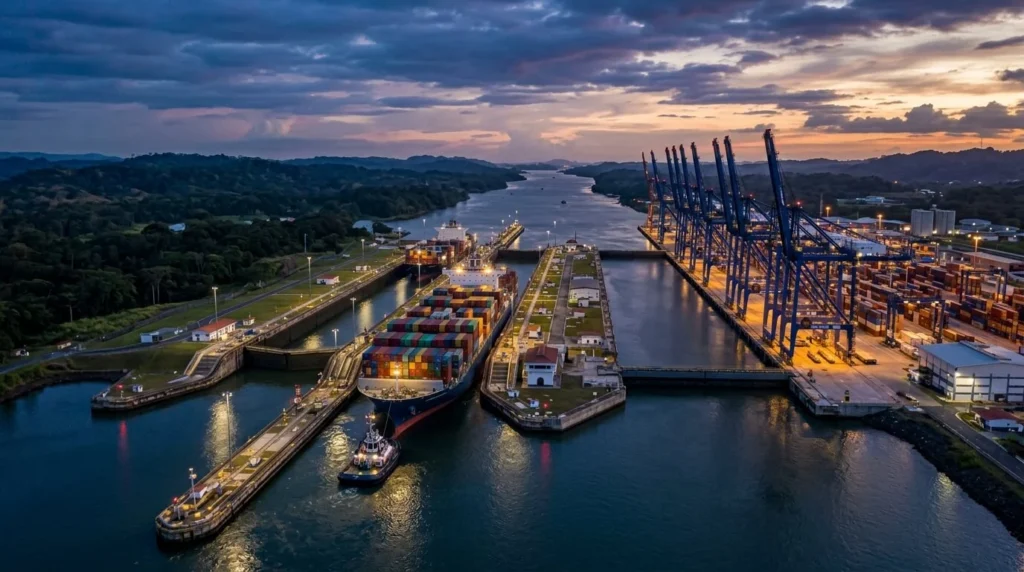
Investing in Panama in 2026: The Future of the Canal and Its Impact on Your Asset Security
When an international entrepreneur evaluates moving their business headquarters or tax residency, the long-term stability of the chosen destination is not a minor detail; it is the backbone of all their planning. Panama once again demonstrates why it leads the region in legal security and infrastructure.
Key Points of this update:
- Mega Logistics Project: Concession and development of the new Corozal (Pacific) and Telfers (Atlantic) terminals.
- Massive Investment: $2.6 billion projected to add between 5 and 6 million annual containers.
- Critical Dates: Pre-qualification for companies closes on July 9, 2026, paving the way for awards in 2027.
- Water Security: Definitive advancements in water governance with the Indio River reservoir to safeguard maritime transit.
Why the Canal is the Best Guarantee for Your Asset Investment?
The Panama Canal Authority (ACP) doesn’t just manage ships. In practice, it acts as the macroeconomic engine that sustains the country’s dollarization and the solidity of its financial center. The announcement of expanding land logistics capacity through new ports demonstrates that the country is not resting on its laurels.
For those looking to invest in Panama, this translates into fiscal certainty. While other economies in the region suffer devaluations and constant tax reforms to finance their budgets, the Panamanian State has a diversified and constantly growing source of income.
The strategic plan for 2050 foresees an increase in Canal revenues, reaching between $6 billion and $10 billion annually. This ensures that the fiscal rules of the game for foreign investors will remain stable and predictable.
“It’s not just about moving containers, but how this robust logistics structure shields the country’s financial sovereignty and offers a safe harbor for global private capital.”
Transformation in Figures: The Logistics Leap Towards 2029
The evolution of transport infrastructure on the isthmus is measured in tangible data. Below, we analyze the projected changes after the commissioning of the new ports on both coasts of the Canal:
| Key Indicator | Current Situation (2026) | Projection (2029 – 2050) |
|---|---|---|
| Investment in New Ports | Pre-qualification phase (Closure: July 9, 2026) | $2.6 billion executed |
| Container Capacity | 21 million annual movements | Addition of 5 to 6 million extra containers per year |
| Annual Canal Revenues | Approximately $4.5 billion | Between $6 billion and $10 billion annually |
| Water Governance | Fragmented management and climatic challenges | Creation of a single water authority and Indio River reservoir |
Economic Substance and Risk Mitigation: The Water Solution
Did recent droughts have an impact? Yes. However, Panama’s institutional response demonstrates why the country generates so much confidence. Instead of improvising, the public administration and the Panama Canal Authority have prioritized the Indio River project and the restructuring of potable water management.
This reaction capacity ensures that operations do not stop. For a multinational company deciding to start a company in Panama, knowing that energy supply and logistics routes are backed by 30-year state plans reduces operational risk to virtually zero.
The Opinion of Our Experts at PanamaWay
Sophisticated investors are not looking for empty promises; they are looking for real infrastructures that support their operations. The Panama Canal is much more than a maritime route. It is the guarantee that the local banking system will remain highly liquid and that the tax incentives of territorial taxation will not disappear.
How does this connect with your relocation or business? A country with this public investment solidity maintains a low inflation environment, exchange rate stability (thanks to the use of the US dollar), and unparalleled air connectivity across the continent.
Case Study: Logistics Structuring for an International E-commerce Business
Last month, an e-commerce client based in Asia and Europe came to us with a recurring problem: high tax rates in their home country and a lack of fluidity in their regional supply chains in Latin America.
We analyzed their asset situation through the lens of the new Panama Canal investments in 2026. Our team designed a 360º solution:
- We incorporated a Limited Liability Company under the advantages of Panama’s territorial tax system.
- We concurrently managed the client’s and their main directors’ residency in Panama.
- We opened their corporate accounts in a top-tier local bank, overcoming the compliance scrutiny of banking officers by demonstrating the real economic substance the client would maintain in local free zones, leveraging the renewed connectivity of the Canal.
The result was immediate and legitimate tax savings, combined with 25% faster logistics operations towards the South and North American markets.
If you wish for us to analyze your situation to structure your business under the protection of the region’s strongest economy, let’s analyze your relocation case without obligation and design a strategy tailored to your asset needs.