
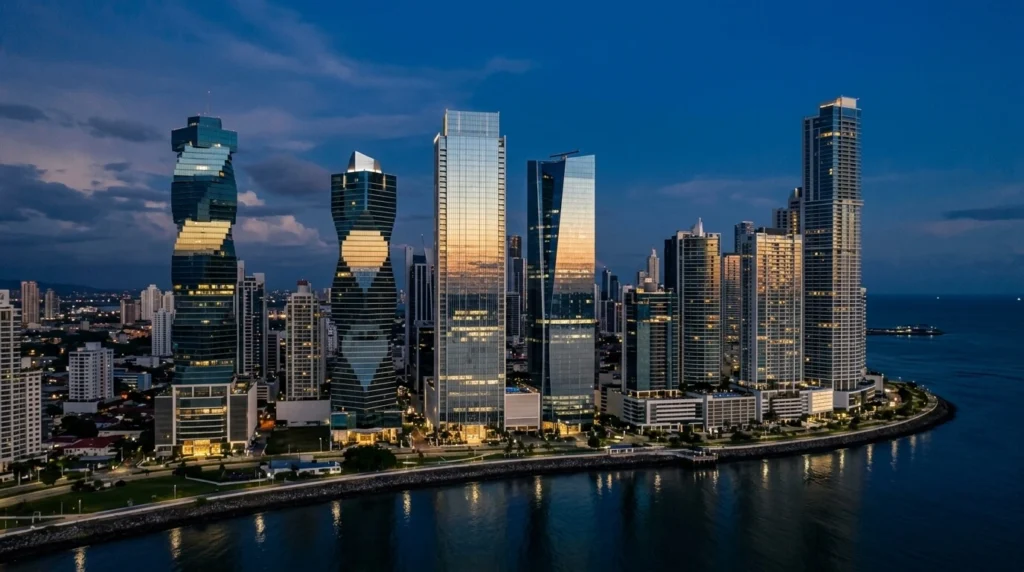
Banking dollarization in Panama in 2026: regional risks and asset security for investors
Banking dollarization in Panama is back at the center of financial debate following the release of Moody’s Ratings’ latest report. For anyone looking to transfer capital or establish themselves in the isthmus, understanding the local banking system is not optional: it’s the cornerstone of any asset protection strategy.
Key Points
- Regional dollarization is receding to 34%, but Panama has operated under a full dollarization model since 1904.
- Zero currency risk: Panamanian bank balances do not suffer from currency mismatches between assets and liabilities.
- Without an issuing central bank, Panamanian banking compensates for the lack of a lender of last resort with high voluntary liquidity buffers.
- Local credit grew a modest 1.3% year-on-year as of June 2026, reflecting a prudent and selective lending policy.
What does this analysis truly mean for a foreign entrepreneur?
Latin America is experiencing evident monetary fragmentation. While countries like Argentina attempt to rebuild their hard currency liquidity and Uruguay maintains 67% of its deposits in dollars, Panama plays in a different league. Here, the concept of forced conversion or local currency devaluation risk simply does not exist.
Comparative Overview: Banking Dollarization in the Region (2026)
Moody’s study presents clear figures that are worth comparing side-by-side:
| Country | Level of Dollarization (%) | Currency Risk in Balances | Main Defense Mechanism |
|---|---|---|---|
| Panama | 100% (Dollarized Economy) | Non-existent | Internal liquidity buffers and international banking |
| Uruguay | 67% of deposits | High for non-exporting borrowers | Central bank reserves and mandatory reserve requirements |
| Argentina | 28% (Increasing) | Severe due to reserve volatility | Currency regulations and credit restrictions |
| Guatemala | Loans/deposits ratio 147% | Moderate | Solid external reserves and correspondent banking |
The Panamanian data is revealing. Since there is no legal tender of its own against the dollar, Panamanian banks do not assume the risk of accepting deposits in one currency and lending in another that depreciates.
“As a fully dollarized economy, Panama lacks currency risk and avoids currency mismatches in bank balances, strengthening depositor confidence.” — Moody’s Ratings, 2026.
The Absence of a Central Bank: Vulnerability or Iron Discipline?
Moody’s points out a recurring technical issue: Panama does not have a lender of last resort. The Republic cannot print money to rescue insolvent entities.
For many regulators trained in the traditional model, this seems like a flaw. However, for private international investors, it is often the greatest guarantee. Banks operating under the supervision of the Superintendency of Banks of Panama know there is no state bailout with taxpayer money.
The result? A culture of strict solvency.
Local banks maintain legal liquidity ratios far above the minimum requirements. They do not lend carelessly. This explains why private credit advanced by only 1.3% as of June 2026, compared to economic GDP growth of nearly 4%. Institutions prefer to shield their balance sheets rather than aggressively expand their portfolios.
If your goal involves establishing an offshore company or relocating business operations, this financial environment imposes clear rules: opening a bank account requires real due diligence, but in return, you are depositing in a market with no risk of inflationary issuance. If you are planning this step, it is advisable to review the framework for starting a company in Panama with solid business substance beforehand.
PanamaWay’s Analysis: Liquidity Management and Solvency in the Panamanian Market
The moderation of domestic credit is not a deterrent to international capital; it is a symptom of the banking center’s maturity. Those who transfer their assets to Panama are not looking for cheap leverage from local entities, but rather a solid jurisdiction to manage treasury surpluses and optimize their personal taxation.
In terms of family and corporate planning, linking operations to the Panamanian territorial system allows for detachment from the instability of Latin American currencies or the European tax net. Combining obtaining tax residency in Panama with bank accounts in local or internationally licensed institutions creates an insurmountable legal barrier.
Let’s look at a real-world case.
A few weeks ago, we worked with Marcos, the owner of a software firm initially based in Montevideo with clients in the United States. After currency fluctuations in the Southern Cone and tax pressure on his dividends, he decided to relocate his company and family. His main concern was precisely Moody’s warning: the supposed lack of Panamanian systemic liquidity.
The initial hurdle came at the compliance desk: a top-tier Panamanian bank rejected his first corporate account application due to a lack of physical business substance. His previous structure lacked substance in Panama. We had to rebuild his file from scratch: we rented office space, documented local hiring flows, and processed his formal residency.
The account became operational within three weeks. Marcos not only eliminated currency risk by invoicing and holding funds directly in US dollars but also activated the exemption from taxes on foreign-source income according to territorial legislation.
Panama is not a lawless paradise; it is a sophisticated financial center that rewards those who do things right from day one.
If you are considering structuring your assets or changing your tax domicile to a dollarized and secure environment, let’s analyze your relocation case with no commitment with our legal and tax team.